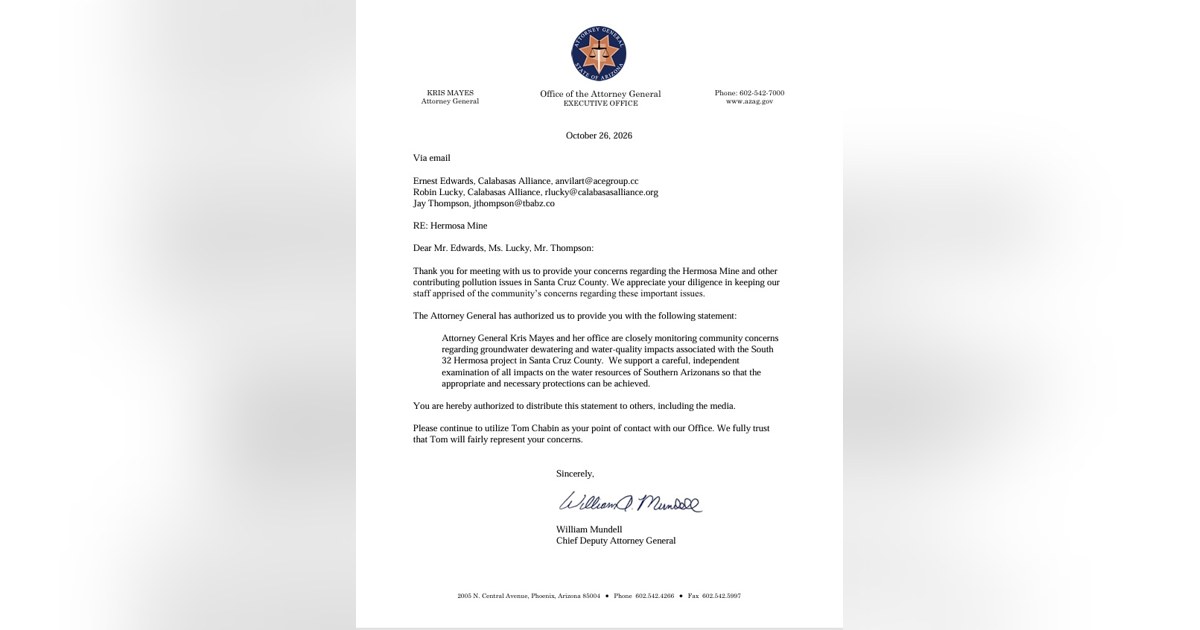
The Office of Arizona Attorney General Kris Mayes has acknowledged community concerns about groundwater dewatering and water-quality impacts tied to the South32 Hermosa Project, lending a significant voice to a growing local push for independent scrutiny of the mine's effects on Southern Arizona's water. The statement, released by the Calabasas Alliance, follows the submission of background information, data, and letters from community members, and it signals that state-level attention is now fixed on how the project could alter aquifers and surface waters.
The attorney general's office said it closely monitors the concerns and supports a careful, independent examination of the project's effects on Southern Arizona's water resources. That endorsement matters because it elevates what has largely been a grassroots effort into a matter with potential regulatory and legal weight. For the groups that have spent months compiling technical evidence, the acknowledgment validates their call for science that is not funded or shaped by the project's sponsor. The full announcement can be viewed through a click here link provided by the organization.
Community members, technical experts, and researchers have identified gaps in how long-term dewatering effects, contaminant pathways, and cumulative impacts on aquifers and surface waters are being assessed. Those gaps prompted the Calabasas Alliance to demand transparent, independently verified science rather than reliance on project-sponsored modeling. The distinction is central to the dispute: project models, however detailed, are produced by the entity seeking approval, while independent hydrologic analysis would be insulated from that conflict and open to public review.
Local leaders warn that high-volume dewatering could create a cone of depression that lowers groundwater levels, threatens wells and surface flows around Patagonia Lake, and necessitates immediate independent hydrologic analysis to secure protections before irreversible damage occurs. A cone of depression is not a theoretical abstraction for residents who depend on private wells and for ecosystems fed by shallow groundwater; once water levels fall, recovery can take years or may not happen at all. The call for immediate analysis reflects a belief that waiting for post-construction monitoring would leave little room to prevent harm.
The implications extend beyond one mine. If the attorney general's support translates into formal review or additional data requirements, it could establish a template for how other large water-intensive projects in rural Arizona are evaluated. It also raises the stakes for South32, which now faces questions not only from neighbors but from a state office with the authority to intervene on environmental and consumer-protection matters. For Santa Cruz County, the announcement reinforces that water is the central issue, and that the credibility of any eventual approval may hinge on whether the science behind it is seen as independent and verifiable.