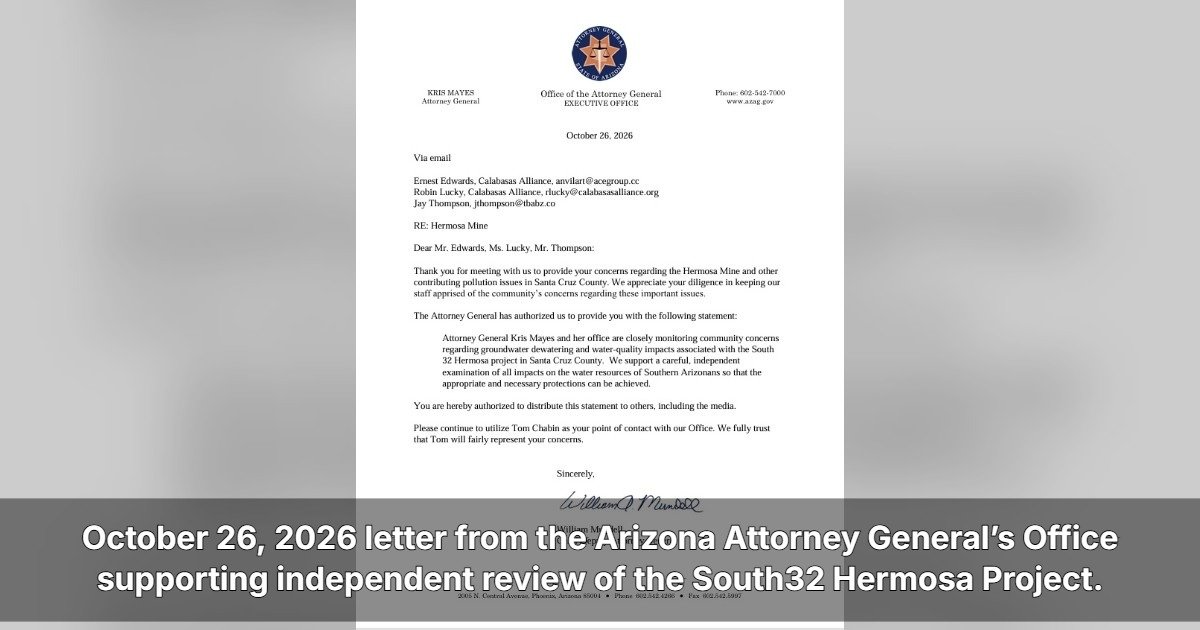
The Office of Arizona Attorney General Kris Mayes has acknowledged community concerns about groundwater dewatering and water-quality impacts tied to the South32 Hermosa mining project in Santa Cruz County, signaling a potential shift toward independent scientific scrutiny of the mine's environmental effects. In a statement released by the Calabasas Alliance, the Attorney General's Office said it “supports a careful, independent examination of all impacts on the water resources of Southern Arizonans so that the appropriate and necessary protections can be achieved.” The statement, transmitted in an October 26, 2026 letter from Chief Deputy Attorney General William Mundell, was expressly authorized for public distribution.
The significance of the Attorney General's intervention lies in its potential to elevate what has been a localized dispute into a matter of statewide regulatory attention. The Calabasas Alliance and other community groups have argued that project-sponsored modeling alone is insufficient to assess long-term dewatering effects, aquifer connectivity, and contaminant pathways. By endorsing an independent examination, the Attorney General's Office lends institutional weight to those calls, increasing pressure on regulators to cross-check industry data against peer-reviewed research and public datasets. This could lead to more stringent permit conditions or additional review requirements for the Hermosa project, setting a precedent for how mining impacts on groundwater are evaluated in Arizona.
Ernie Edwards, president of the “B” Property Owners Association and a Lake Patagonia resident, warned that the pending cone of depression from dewatering poses a direct threat to residents. “High-volume pumping will lower groundwater levels across a wide area, affecting wells, surface flows into the lake and the connected aquifers that supply our community and the Santa Cruz Active Management Area,” Edwards said. He called for independent hydrologic analysis “now, rather than relying solely on South32 consultant models, to understand the full extent of these impacts and ensure effective protections are in place before irreversible drawdown or ground subsidence occurs.”
Robin Lucky, president of Calabasas Alliance, said the group appreciates the Attorney General's recognition that community concerns warrant independent examination. “Massive dewatering will alter aquifer levels for decades, and questions remain regarding arsenic and other heavy metals in wells and the broader impacts in county,” Lucky said. “Transparent, science-based independent assessments are essential to safeguarding Southern Arizona's water resources and the health and well-being of our citizens.” Lucky also noted that these concerns compound longstanding pollution challenges in Santa Cruz County, including some of the highest PFAS levels detected in Arizona drinking water, according to EPA and ADEQ reports, and poor air quality in Nogales.
The announcement underscores a growing demand for transparency in environmental permitting, particularly where water scarcity is a pressing concern. If the Attorney General's support translates into formal independent review, it could bolster public confidence in regulatory decisions and ensure that protections for land, air, water, and public health are grounded in the best available science rather than project-sponsored assumptions. For residents and advocacy groups, the statement represents a critical opening to insist that the full scope of dewatering impacts—from well interference to surface-water depletion—be rigorously and independently verified before irreversible harm occurs.