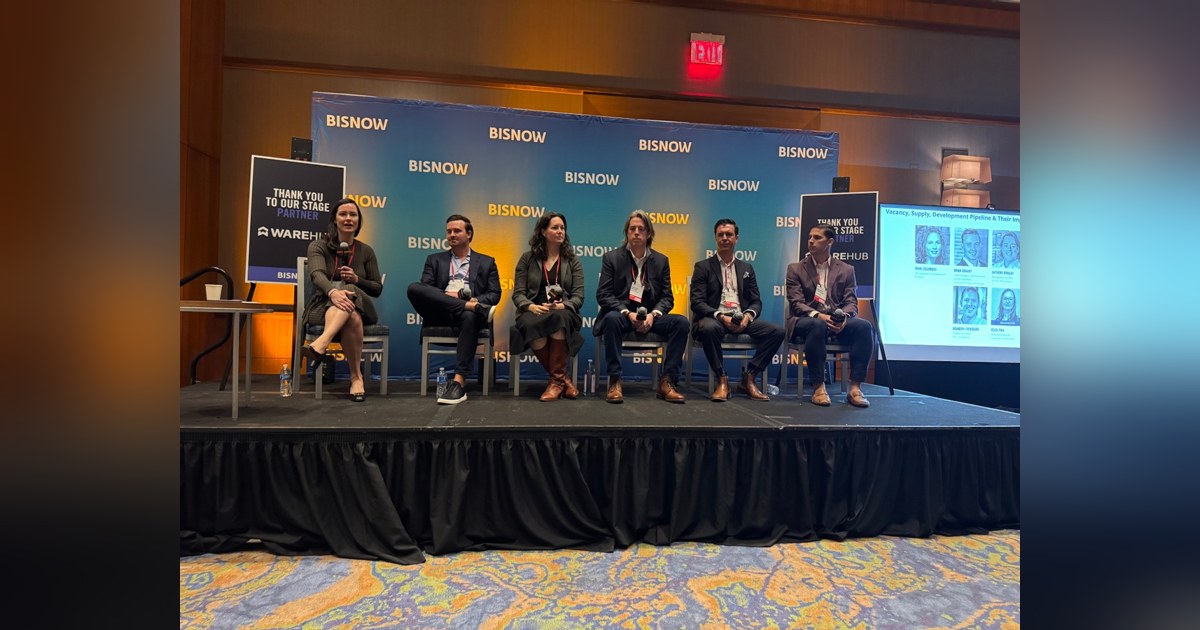
James Holbrook, Founder and Executive Chairman of Warehub, joined other industrial real estate leaders at Bisnow's Northeast Industrial & Manufacturing Conference in Jersey City on October 21 to discuss how tenant requirements, supply dynamics and leasing strategies are reshaping the market. His remarks centered on two pressing challenges: helping tenants future-proof their real estate strategies and enabling landlords to turn vacancy into revenue.
Holbrook argued that the industry must look beyond individual buildings and instead create digital infrastructure that lets tenants adapt their real estate strategies, optimize distribution networks and reduce transportation costs. That approach, he said, is essential as supply chain flexibility becomes a competitive differentiator. The full announcement, including downloadable images and bios, is available for those who click here.
On the landlord side, Holbrook highlighted how flexible, short-term leasing can help institutional owners monetize vacant space, improve near-term asset performance and meet evolving tenant demand without compromising long-term leasing objectives. That message carries weight at a time when industrial vacancy has risen in several markets, prompting owners to seek new ways to generate income from underutilized properties.
Warehub positions itself as an operating system for industrial real estate, connecting demand, inventory and execution through a single intelligent platform. By standardizing property data, digitizing leasing workflows and coordinating the participants required to activate industrial space, the company aims to help landlords, tenants and brokers move from requirement to occupancy with greater speed, transparency and efficiency. More information is available at warehub.com.
The implications extend beyond a single conference panel. As industrial tenants demand greater agility and landlords face pressure to perform on vacant assets, platforms that digitize leasing and standardize data could become a foundational layer for the sector. Holbrook's emphasis on digital infrastructure suggests that the next phase of industrial real estate competition may hinge less on square footage and more on how quickly and transparently space can be matched to need. For an industry long accustomed to long-term leases and paper-driven processes, that shift could reshape how deals are sourced, executed and financed.