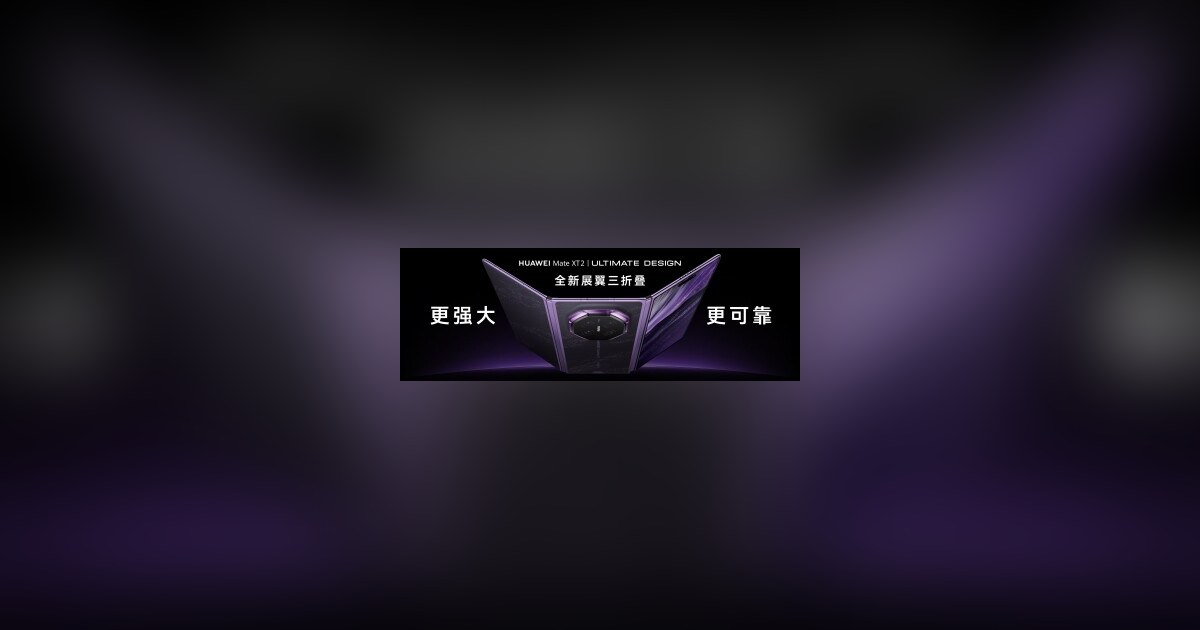
Huawei has released the HUAWEI Mate XT 2 | ULTIMATE DESIGN trifold smartphone, the first device to run HarmonyOS 7 and the first to feature the LogicFolding Tau (τ) chip, the Kirin 9050 Pro. The launch signals a significant shift in smartphone engineering and semiconductor design, with implications that extend well beyond a single device. According to Media OutReach Newswire, the phone is the industry's slimmest and largest foldable, measuring just 3.5mm thick when open.
The Mate XT 2's foldable wing-like form allows it to transform into a tablet, but the real breakthrough lies inside. The Kirin 9050 Pro chip, designed by Huawei's HiSilicon team, is the first to use LogicFolding, a 3D integration technique that stacks transistors vertically rather than shrinking them laterally. This approach addresses the growing limitations of Moore's Law, the decades-old observation that transistor counts double roughly every two years. As geometric scaling becomes physically and economically harder, Huawei's alternative, the τ (Tau) Scaling Law, proposes measuring chip performance by time rather than size.
The implications are substantial. In the Kirin 9050 Pro, transistor density has risen from about 155 to 238 million transistors per square millimetre, an increase equivalent to what was achieved over the previous three years using traditional shrinking. More importantly, LogicFolding reduces the distance data must travel, cutting power consumption. This matters not only for smartphones but for large AI clusters, where up to 80% of energy is spent moving data rather than processing it. The breakthrough suggests that future chips could deliver more performance while running cooler, a critical factor as AI workloads grow.
He Tingbo, President of Huawei's HiSilicon division, recently named one of Time Magazine's leading AI innovators, explained in an IEEE article that the most energy-intensive part of a chip's operation is data transmission, not processing. By reducing that 'commute,' LogicFolding chips run cooler per unit of work even at higher densities. This contradicts previous assumptions that stacking transistors would cause overheating, and it positions Huawei as a leader in post-Moore semiconductor design.
The Mate XT 2 also debuts HarmonyOS 7, which is 42% more powerful than the previous generation. The cover screen spans 6.5 inches, boosting the screen-to-body ratio from 86.4% to 92.8%, with 70% better anti-reflection. A world-first Smart Shield Privacy Screen on a foldable uses two independent pixel sets to switch from wide to narrow viewing angles without sacrificing clarity. Additionally, the device introduces industry-first ECG analysis, allowing users to capture a 30-second ECG by holding both side frames when unfolded.
Huawei's commitment to research and development underpins these advances. More than half of its employees work in R&D, over 100,000 people, and the company holds 160,000 active patents worldwide. In the first half of 2026 alone, R&D investment exceeded RMB 121 billion, accounting for 25.94% of revenue, up 25.2% year on year. The Mate XT 2 starts at RMB 19,999 and launched officially on September 12th.
For consumers, the Mate XT 2 represents a new era of foldable performance and health monitoring. For the industry, it marks the mass commercialization of a chip design that could reshape how semiconductors are built as traditional scaling reaches its limits. Huawei's ability to innovate under external restrictions makes this launch not just a product milestone, but a strategic statement about the future of computing.