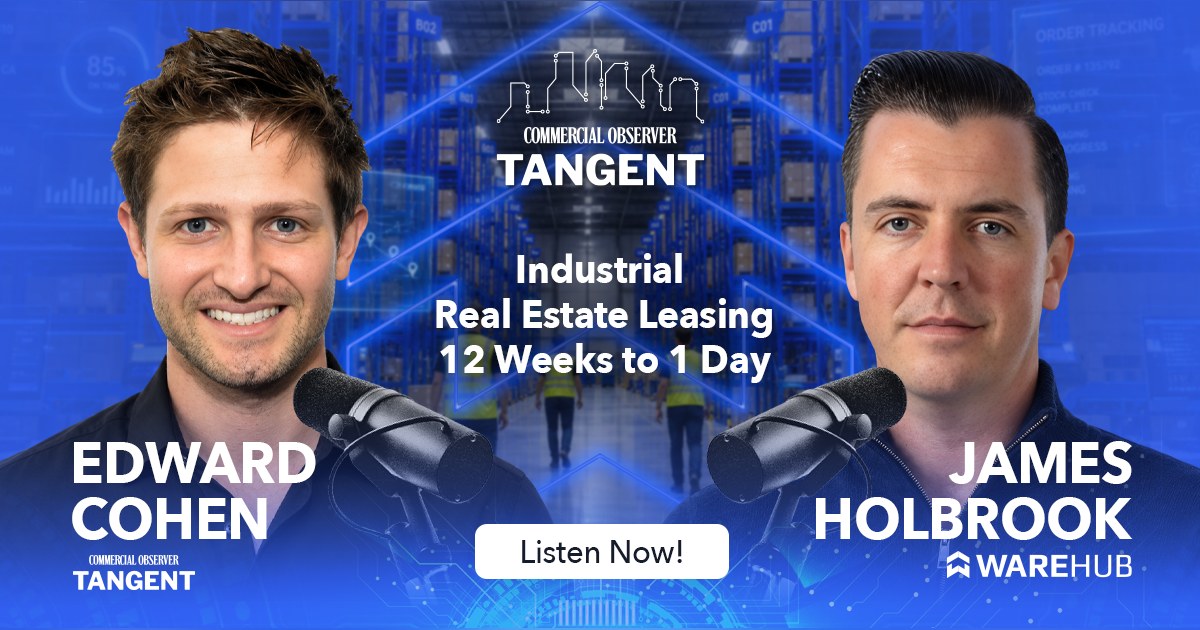
James Holbrook, Founder and Executive Chairman of Warehub, appeared on Commercial Observer's Tangent podcast with host Edward Cohen to discuss how industrial leasing can better serve the changing needs of modern logistics. The conversation centered on a connected digital process that helps businesses secure warehouse space faster, gives landlords more opportunities to generate income from vacancy, and allows brokers to spend more time advising clients. For an industry accustomed to lengthy negotiations and fragmented communication, the implications are significant: a shift from a relationship-driven, paper-heavy process to a standardized, technology-enabled marketplace could fundamentally alter how industrial space is leased.
The key takeaway is speed. Warehub can reduce the process from receiving a tenant requirement to executing a lease from a typical 12 weeks to one day. That compression matters because delays in securing warehouse space directly impact supply chains, inventory costs, and a tenant's ability to meet customer demands. For landlords, faster lease execution means vacant space begins generating income sooner. For brokers, less time spent on administrative coordination means more time for high-value advisory work. Tenants, landlords, brokers, and service providers can discover space, coordinate terms, execute standardized lease documents, and manage the activities needed to begin and support occupancy through a single platform.
Warehub's traction suggests the model is gaining acceptance. The company had onboarded more than 52 million square feet across approximately 40 U.S. markets, with more than 200 users and 368 suites. That scale indicates that a critical mass of industrial real estate participants are willing to adopt a standardized digital process, which is often the hardest hurdle in commercial real estate technology adoption. If the platform continues to grow, it could pressure competitors to offer similar speed and transparency, ultimately raising expectations across the industry.
Warehub is building the operating system for industrial real estate, connecting demand, inventory, and execution through a single intelligent platform. By standardizing property data, digitizing leasing workflows, and coordinating the participants required to activate industrial space, Warehub enables landlords, tenants, and brokers to move from requirement to occupancy with greater speed, transparency, and efficiency. More deals. Less friction. Faster payment. For more information, visit Warehub.com. The full announcement, including downloadable images and bios, can be viewed click here.
The broader implication is that industrial leasing may be on the cusp of a platform revolution similar to what occurred in residential real estate or travel. If Warehub succeeds in becoming the default operating system for industrial space, it could reduce transaction costs, improve market liquidity, and make it easier for businesses to adapt their logistics networks. That flexibility is increasingly vital as e-commerce, reshoring, and supply chain resilience drive demand for modern warehouse facilities. Holbrook's podcast appearance thus serves as both a progress report and a signal that the industry's digital future is arriving faster than many expected.